Cattle drives, open range, cowboys … these are the images we bring to mind when we think of the Old West. It is an image that might have endured into modern times had the winter of 1886–87 not happened.
After a run of mild winters on the northern plains, many ranchers had come to count on their cattle weathering the winter by grazing on wild grasses, so little hay had been put up for winter feeding. The southern plains had not been so lucky: blizzards in the winter of 1885–86 had already killed thousands of cattle trapped against drift fences in the Texas Panhandle. The summer of 1886 was unusually hot and dry throughout the West and particularly in the Southwest. Prairie fires ran wild and water sources dried up. Old-timers, who knew the signs, were worried, especially when the cattle began growing unusually heavy coats and eating more than normal. Based on the signs, they predicted a hard winter.
Snow started falling in late fall, far too soon for many folks to get prepared. Across the northern and central ranges, from Montana, Wyoming and Dakota Territory down into Colorado, storm after storm buried the grass through November and December. The cattle were forced to paw through deep snow to find a few nourishing stems of grass, but it wasn’t enough, and cattle died by the thousands. In January, a Chinook wind blew and melted the top layers of snow, greatly relieving the cowboys’ worries. They felt the rest of the cattle might make it through the winter if not healthy, at least alive. That’s when Mother Nature tossed her worst at the West.
Temperatures dropped to 50 below zero and colder, causing a layer of ice to freeze solid over the snow beneath. Horses and cattle cut their hooves and feet on the sharp crust and wore the hair off their legs to the knees. Then the snow fell again and death stalked the land.
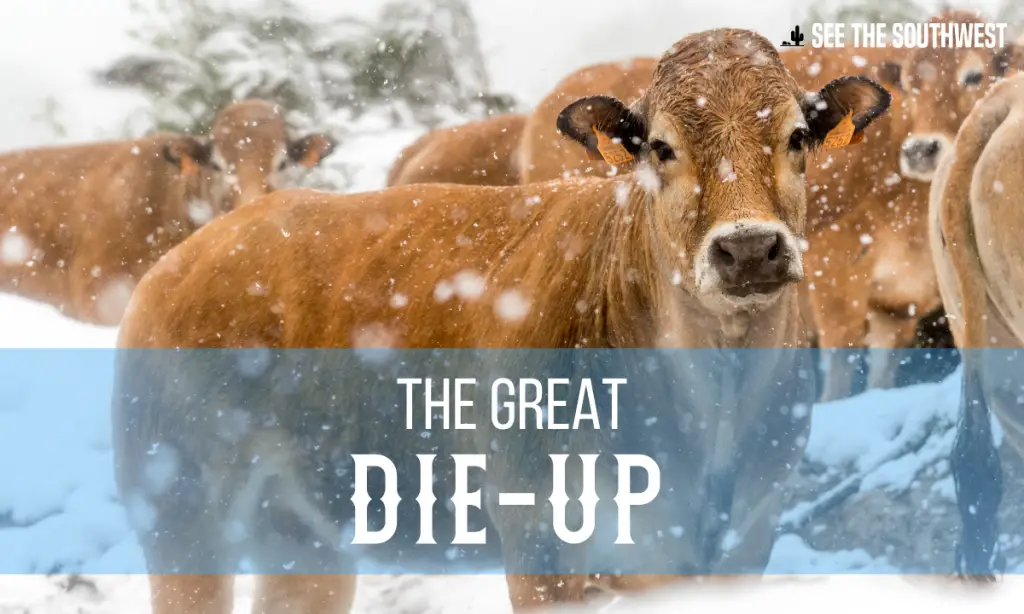
When spring finally came in 1887, the losses were staggering. Estimates ran from about a quarter of the herds on Colorado’s northern Front Range to roughly 60 percent across Montana, and some outfits lost 90 percent or more. Hundreds of thousands of animals lay dead, their carcasses rotting in the sun. The few remaining cattle were in poor health, weak and suffering from frostbite. Many ranchers went broke and the rest struggled to hang on. The event came to be known as the Great Die-Up, or the Big Die-Up, and it changed the face of the West.
The best-known picture of that winter came from a young cowhand. Charles M. Russell was working on the O-H Ranch in Montana’s Judith Basin when the ranch’s owner wrote asking how the herd had come through the winter. In reply, the foreman sent back a small watercolor Russell had painted of a gaunt, starving steer standing in the snow, watched by wolves. Russell’s caption, Waiting for a Chinook, became its title, and the image was published widely and launched Russell’s career as one of the West’s great cowboy artists.
After that hard winter, ranchers kept smaller herds closer to home and put up hay and other feed to carry them through the winter. Wandering cowboys had to find other work or settle for work as ranch hands. Farmers moved in, fencing more of the range, and new rail lines, merchants, schools and churches followed.
The open-range cattle business never recovered from the winter of 1886–87, and the great trail drives and free-roaming cowboys of that era passed into legend. So ended the days of open range and a whole way of life, which now lives on only in our imaginations and stories.