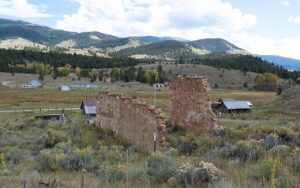
Long ago, according to Acoma tradition, the ancestors of today’s Acoma people built one of the strongest settlements in the Southwest high in the sky. It was located atop a sandstone butte 430 feet high, 400 feet wide and 1,250 feet long. The massive outcrop is comprised of Zuni Sandstone, topped by a harder layer of Dakota Sandstone that prevents the top from eroding away. Today, the butte is known as Mesa Encantada, or Enchanted Mesa, a name that suits its towering presence above the plains. In their Keres language the Acoma call it Katzimo (also spelled Kadzima). The Acoma people who lived atop the mountain farmed in the valley below, descending via a section of mesa that had broken loose — the debris made a steep but usable ramp to the plains.
Sometime long before the Spanish arrived — no one is really sure of the date — a great storm rumbled across the land while the villagers were working the fields below the mesa. They took shelter but watched in fear as great torrents of rain fell from the sky and the access ramp was washed away. Acoma legend says that three old women and a young boy were left behind in the village. With the ramp washed away, none of the men could get back to rescue them. Then a great thunderbird swooped down and carried the four to the valley floor. Another version of the story says that a young girl and her grandmother were stranded on top when the ramp washed away. Rather than perish from starvation, the two leaped from its cliff walls.
Taking it as a sign, the Acoma people abandoned Enchanted Mesa and moved to nearby White Rock Mesa, now called Acoma Pueblo or The Sky City. That is the village the first Europeans saw. In 1540 Hernando de Alvarado, an officer in Francisco Vázquez de Coronado’s expedition, reached Acoma and called it one of the strongest places his men had seen. The only way up was a long hand-built stairway followed by toeholds cut into the rock, and Alvarado admitted the party regretted making the climb. He also described houses three or four stories high and people well supplied with corn, beans and turkeys. Today, you can visit the Acoma Pueblo and see how the Acoma people lived centuries ago. Many tribal members still live in the Acoma Pueblo (Sky City) and the nearby villages. While most don’t live in the ancient pueblo full time as none of the dwellings have electricity, sewer or running water, they do return for special cultural occasions, and the Acoma potters still carry on their centuries-old tradition of making finely crafted Pueblo Indian Pottery. Visiting the Sky City is a privilege granted by the Acoma Tribal Council, and the only way to see it is on a guided tour that starts at the Sky City Cultural Center and Haak’u Museum at the foot of the mesa. As of November 2026, the center is open Friday through Monday with three tours a day, and it closes on set dates each year for cultural observances, plus occasional unannounced closures for ceremonies or weather. Groups of 10 or more must reserve a tour in advance. Check the annual closure calendar or call ahead before you go. If you want to take pictures, buy a camera permit at the cultural center first; cameras are not allowed on feast days.
Enchanted Mesa itself, about 2.5 miles northeast of Sky City and roughly 60 miles west of Albuquerque, is not part of the tour. The Pueblo asks visitors on its lands to stay on the highway and prohibits off-road sightseeing and rock climbing, so admire the butte from a distance. It is in plain view from the Sky City mesa top.
Other attractions in the area include:
ABQ BioPark in Albuquerque (Zoo, Aquarium, Botanic Garden and Tingley Beach)
Ice Cave and Bandera Volcano (privately owned; closed in winter, November 1 to March 1)
Chaco Culture National Historical Park (reached on long unpaved roads that can become impassable when wet; storm damage closed the north entrance road in fall 2026, so check road conditions first)
El Malpais National Monument
El Morro National Monument (on winter hours from mid-October to late May, when the visitor center and trails close on Tuesdays and Wednesdays; check current hours)